Schwanthaler Trompetenconsort
Gold and jewels, velvet and silk, magnificently adorned horses and a court dazzling in every respect: such associations come to mind today when we think of the splendour of princely and imperial courts from the 16th to the 18th centuries. Yet a very essential aspect of representation was, of course, music — and what, the fastidious potentates of the Renaissance and Baroque were thinking, could be more suitable to underscore their own superiority than trumpets and timpani; preferably as many of them as possible?
This preference of well-appointed and ambitious rulers naturally inspired — and financed — many composers of past centuries to write works for such trumpet corps: entrances and fanfares for state visits or equestrian ballets at court, sacred works for processions and services, as well as secular music for edification and entertainment.
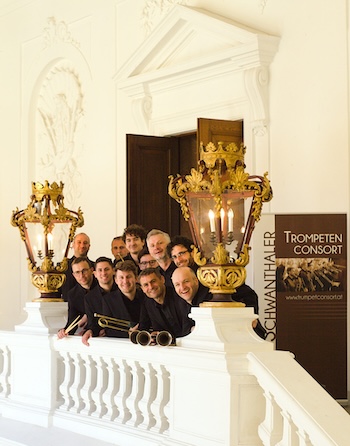
In order to bring this extraordinarily splendid music back to life today, the Schwanthaler Trompetenconsort was founded in Austria in the year 2000, an ensemble usually consisting of around eight Baroque trumpets and a timpani, supplemented depending on the programme by additional trumpets, singers, organ, or trombones. The ensemble performs exclusively on Baroque instruments in order to revive the historical sound that, at the Imperial Court in Vienna (with up to 24 trumpets!) and other courtly metropolises, represented the power of the respective rulers 200 to 500 years ago. The Consort is thus among the very few groups worldwide whose instrumentation and technical mastery enable them to make this splendour of sound accessible to modern audiences once again: impressions that listeners do not soon forget!
The great fascination for the musicians themselves lies, for example, in mastering the finely chiselled coloraturas demanded by this repertoire, but also in playing across the entire dynamic spectrum of such a brass group, from the most delicate pianissimo to the concentrated radiance of eight or twelve trumpets — which, thanks to the warm brilliance of the Baroque instruments, is never perceived by the audience as unpleasantly loud.
Internationally, the ensemble first attracted wide attention after winning the main prize at the Biber Competition in St. Florian in 2011. Since then, concert invitations have followed to venues such as the WDR Broadcasting House in Cologne, the Tage Alter Musik Regensburg, the Tage Alter Musik Herne, the Vienna Konzerthaus or the Musikverein there, the Festival Oude Muziek Utrecht, and many other renowned stages. The group’s first CD, L’Arte della Trombetta, also received enthusiastic reviews in Austria and abroad, and numerous radio recordings testify to the high quality of their performances.
This special ensemble is also frequently invited to collaborate on individual projects with other groups, such as Ars Antiqua Austria or the Wiener Akademie, the L’Orfeo Baroque Orchestra, Akamus Berlin or the Dresden Festival Orchestra.
SONUS on the Schwanthaler Trompetenconsort:
Hearing eight, ten or twelve trumpets playing together – that is simply … wow!!!
And unfortunately, one hears this far too rarely today: in many places it already seems difficult enough to find even three reasonably acceptable Baroque trumpeters for Bach's Mass in B minor, and to hear more than four good Baroque trumpets playing together on today's concert stages can be counted as an absolute exception.
So it is a pure pleasure to experience this formation live with its resplendent repertoire – and the fact that the Schwanthaler musicians also play with such perfect homogeneity, such virtuosity, such splendour of sound, at the same time so sensitive and so secure in intonation, brings this delight for me to its culmination. This delicate clarino playing: dreamily floating! This almost organ-like blend in tasteful piano passages: irresistibly rounded! The polyphonic interplay in the repertoire of the late Renaissance or early Baroque: almost vocally flexible and yet so radiant!
This ensemble thus leaves lasting impressions on its listeners time and again and also demonstrates that the image, established in the 20th and 21st centuries, of the brass ensemble as a beer-tent combo with a tankard under the chair covers only a vanishingly small (and not really the most delightful …) part of the possibilities of such instruments. Not without reason were master trumpeters in the Renaissance and Baroque the best-paid musicians of all, passed from court to court and held in the highest esteem.
And even though, unfortunately, remuneration in the early music scene today is far more modest than in earlier centuries, the appeal of of a technically perfectly played Baroque trumpet can only be surpassed by one thing: the appeal of eight to twelve Baroque trumpets sounding at the same time!
Audio samples
Joseph Küffner: Grande Marche (Liverecording)
Franz Xaver Schantl: Aufzüge zur Fronleichnamsprozession No. 4 and 7 (Liverecording)
Johann Georg Gruber: Ein Deutscher (Liverecording)
Visit the Schwanthaler trumpets also on our YouTube channel!